614.918.0050
 Westerville, OH
 614.918.0050
 Westerville, OH


Yoga for older adults is an adaptable form of movement that combines gentle poses, breathing, balance practice, and relaxation. Depending on your comfort and mobility, yoga can be done while seated, with a chair for support, standing, or on a mat. The best approach is one that helps you move slowly and remain in control.
You do not need to be flexible or experienced to begin. You simply need movements that match your current abilities. At The Gables of Westerville in Westerville, Ohio, yoga classes are one of several ways residents can stay active and engaged. Here, you will learn about yoga formats, possible benefits, gentle poses, safety considerations, and guided senior fitness programs.
What Is Yoga for Older Adults?
Yoga for older adults is an adaptable mind-body practice that may include gentle physical poses, controlled breathing, balance exercises, and quiet relaxation. Movements may be completed while seated, standing with support, standing independently, or lying on a mat.
That flexibility allows yoga to meet different mobility and balance needs. Yoga does not have to involve deep stretches, complex positions, or getting onto the floor. A movement can be made smaller, performed more slowly, or completed with a sturdy chair.
How Yoga May Support Balance, Movement, and Everyday Wellness
Research suggests yoga may support some aspects of physical function, but the findings are not consistent across every outcome. A 2025 systematic review of randomized trials involving older women found mixed results for balance, gait, and lower-limb strength and did not establish a definite effect on fall prevention.
These possible benefits of yoga for older adults matter because everyday life involves many small movements. Turning to reach an item, rising from a chair, walking through a room, getting dressed, and joining an outing all require some combination of balance, strength, flexibility, and body awareness.
Balance and Body Awareness
Slow yoga movements encourage you to notice your posture, weight shifts, and body position. Balance practice does not guarantee that a fall will be prevented, but it can be one useful part of a broader wellness and fall-safety routine. More than 14 million adults age 65 and older, or about one in four, report falling each year in the United States, and falls are the leading cause of injury in this age group, according to the Centers for Disease Control and Prevention.
Flexibility and Comfortable Movement
Gentle stretching may help you maintain or improve your comfortable range of motion. Flexibility is not something you must achieve before starting yoga. It is one of the areas you can explore gradually, without forcing your body into a position.
Strength and Postural Support
Holding a seated or standing position can engage your muscles even when you are not using weights. Yoga may involve the legs, hips, abdomen, back, shoulders, and arms, depending on the poses and modifications you choose.
Breathing, Relaxation, and Mental Focus
Yoga is not only about physical poses. Slow breathing and focused attention may help you settle into the movement and remain aware of how your body feels. This can make the practice feel calmer and less focused on performance.
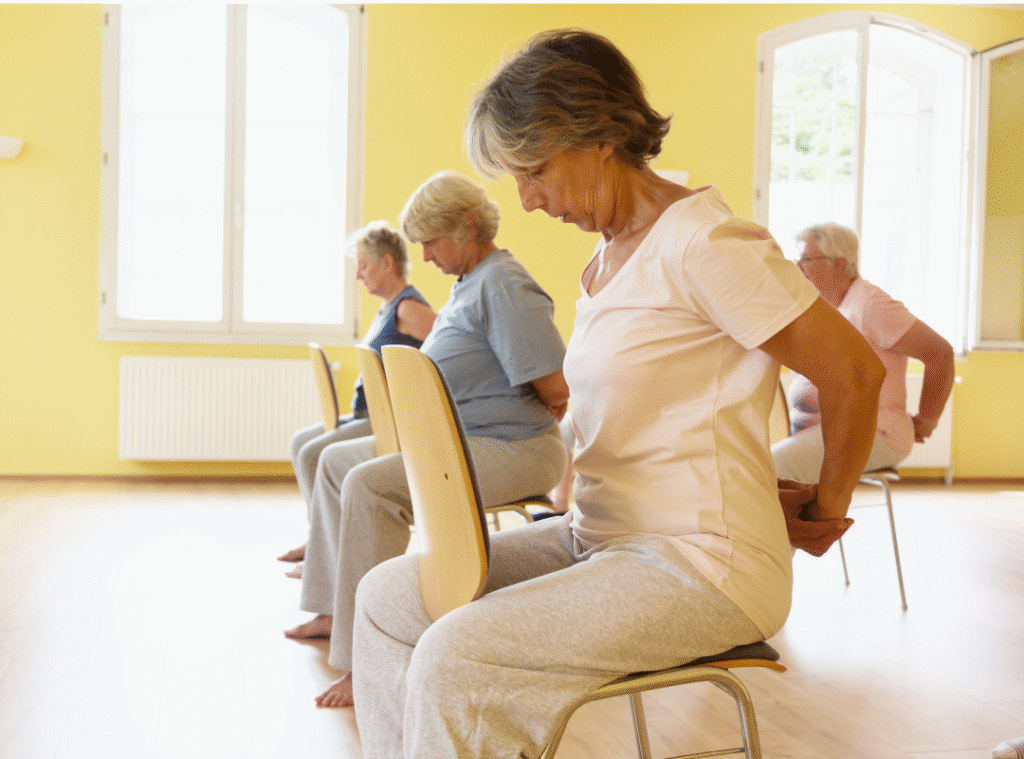
Chair, Standing, or Floor Yoga: Which Format Fits You?
The best yoga format is the one that matches your present balance, mobility, and comfort. Chair yoga is not automatically the right choice for every older adult, just as floor yoga is not a goal everyone needs to reach.
| Yoga format | May suit someone who | Support commonly used | What to consider |
| Chair yoga | Prefers seated movement or has difficulty reaching the floor | A sturdy chair | Feet should feel supported, and the chair should remain stable |
| Chair-supported standing yoga | Can stand but wants added stability | A chair or wall | Weight shifts and transitions should remain slow and controlled |
| Gentle standing yoga | Is comfortable standing without assistance | Optional wall or prop | Balance demands may be greater |
| Floor-based gentle yoga | Can comfortably get down to and rise from the floor | A mat or other approved props | Getting to and from the floor is part of the decision |
Choose a format that allows you to breathe normally, move without rushing, and stop comfortably. A more difficult-looking pose is not always more useful. The type of yoga that feels right may also change on days when you feel tired, stiff, or less steady.
The National Institute on Aging includes yoga among activities that can support balance and notes that older adults benefit from combining balance work with aerobic and muscle-strengthening activity.
Gentle Yoga Poses for Seniors and How They Can Be Adapted
The most useful yoga poses for seniors are not necessarily the most impressive ones. A good starting pose should feel controlled, allow steady breathing, and be easy to leave if you become uncomfortable.
These general examples are not a personalized exercise plan, so keep each movement comfortable and follow any guidance from your healthcare professional.
Seated Mountain Pose for Posture and Breathing
Sit with your feet supported and your hands resting comfortably. Gently lengthen your posture without stiffening your back or lifting your shoulders. This position can serve as a calm starting point for noticing your breathing and body alignment.
Seated Side Reach for Gentle Upper-Body Movement
While seated, raise one arm only as far as feels comfortable and lean slightly toward the opposite side. Keep the movement small enough that you can remain steady and breathe normally. Return to the center before changing sides.
Seated Cat-Cow for Gentle Spinal Movement
Sit upright and slowly alternate between a slight rounding and a gentle lengthening of your back. The movement does not need to be large. Focus on comfort and control, not how far you can move.
Seated Knee Lift for Controlled Lower-Body Movement
While seated with both feet supported, lift one foot a small distance and lower it with control. You may also keep the foot on the floor and focus on gently shifting pressure if lifting is not comfortable.
Supported Standing Balance Practice
Stand beside or behind a stable support and shift your weight slightly from one foot toward the other. Keep both feet on the floor if that feels most secure. Stop if you feel unsteady or cannot maintain control.
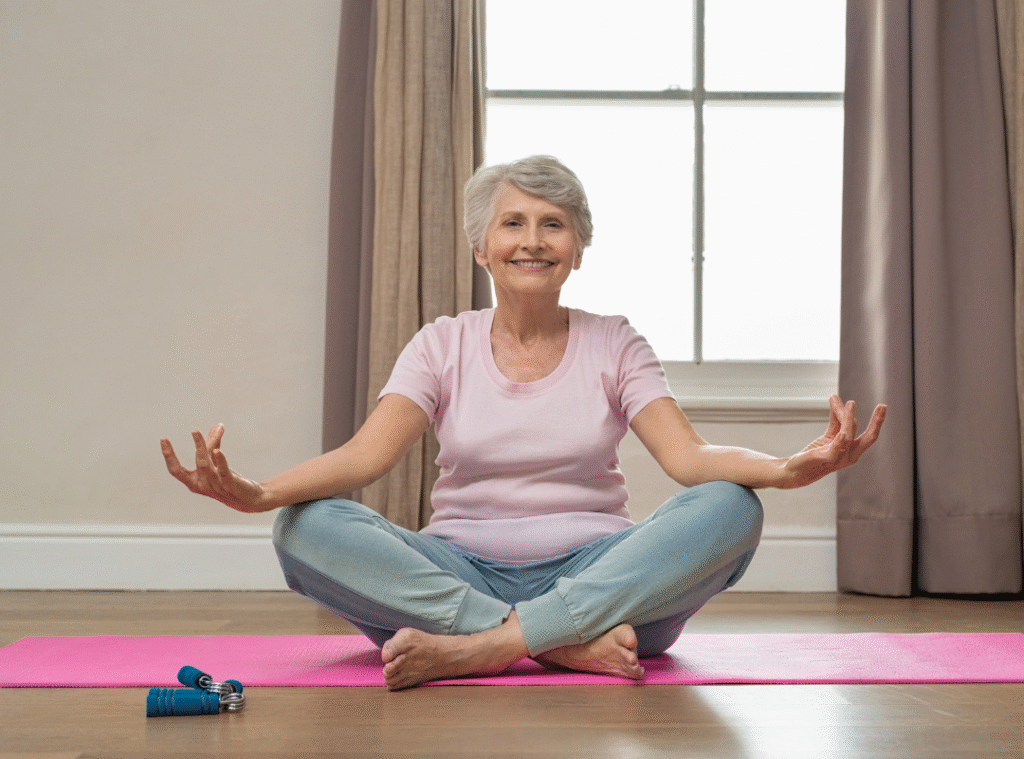
A Safer Way to Begin Yoga Later in Life
A safer yoga practice begins with choosing the right environment, pace, and level of support. You should be able to stop, rest, or modify a movement at any time without feeling that you have failed.
The SUPPORT framework can help you remember the main considerations:
- Start with a stable setup: Clear the area and use a sturdy chair when support is needed.
- Understand your current limits: Base the session on how your body feels that day.
- Practice slowly: Avoid fast transitions, bouncing, or forcing a stretch.
- Pause when something feels wrong: Stop with pain, dizziness, unusual shortness of breath, or loss of control.
- Obtain guidance when needed: Ask a healthcare professional about restrictions and seek an instructor familiar with older adults.
- Respect modifications: A seated or smaller version is still a valid movement.
- Track how you feel: Notice your comfort during the session and afterward.
Tell your healthcare professional about any recent surgery, unexplained symptoms, balance concerns, or medical restrictions before beginning. Pain is a reason to stop, not something to push through. Choose movements you can perform comfortably and with control.
When a Guided Senior Yoga Class May Be Better Than Practicing Alone
A guided class may be helpful when you are new to yoga, unsure how to adapt poses, or more comfortable learning through demonstration. An instructor can explain the movement, remind participants to slow down, and offer appropriate variations when those options are part of the class.
As you compare senior fitness programs, look beyond the class name. Ask whether the pace is suitable for older adults, whether seated options are available, and whether participants are encouraged to rest or skip movements. Helpful qualities include:
- Clear, easy-to-follow instructions
- Movements that can be modified
- Stable seating and enough space to move
- A pace that does not rush transitions
- A welcoming approach that values participation over performance
For many people, uncertainty is the biggest barrier. You may wonder whether everyone else will be more experienced or whether you will be able to keep up. A supportive class should make modifications feel normal and allow each participant to work at a comfortable level.
How to Make Gentle Movement Part of a Consistent Wellness Routine
Consistency is often easier when movement fits naturally into your day. A short, manageable session may be more useful than an ambitious routine that leaves you tired or discouraged. You might choose a time when your energy is usually stronger, attend a scheduled class, or connect yoga with another familiar part of your routine. For example, you might practice a few gentle movements after getting dressed or before a regular afternoon activity.
Yoga can also be one part of a varied lifestyle. At The Gables of Westerville, residents have access to yoga classes along with art classes, book club, interactive lectures and presentations, Friday happy hour, Sunday movie or musical matinees, and outings to local museums and restaurants. Variety gives you more ways to participate according to your interests and how you feel that day.
Families who are exploring the role of activities in community life can also read about senior living activities that support purpose, friendship, and daily joy.
You can also use the Lifestyle Assessment to think through the routines, interests, and experiences that may matter most in your next chapter.
Explore an Active Lifestyle at The Gables of Westerville
Healthy aging is not measured by how deeply you can stretch or how long you can hold a pose. What matters is finding appropriate ways to move, connect with others, and take part in a routine that feels meaningful. Yoga classes at The Gables of Westerville are offered alongside dining, creative activities, educational presentations, local outings, and social gatherings. The community provides Independent Living, Assisted Living, and Memory Care options, allowing families to explore lifestyle opportunities together with available support.
See how wellness and daily life come together by planning a visit to The Gables of Westerville. You can also contact the community or call 614-918-0050 to ask about yoga classes, activities, care options, and what to expect during a tour.
Frequently Asked Questions
Can a 70-year-old do yoga?
Yes, many 70-year-olds can participate in a form of yoga that matches their abilities. Age alone does not determine whether yoga is appropriate, because balance, mobility, medical conditions, and exercise experience vary from person to person. Chair yoga or supported movements may be more comfortable for someone who does not want to get onto the floor. Speak with a healthcare professional before beginning if you have medical concerns, recent surgery, unexplained symptoms, or exercise restrictions.
What type of yoga is best for older adults?
There is no single type of yoga that is best for every older adult. Chair yoga may work well if you prefer seated support, while gentle standing yoga may suit someone who feels steady on their feet. Floor-based yoga may be appropriate when getting down and back up is comfortable. Choose a class or routine that matches your balance, mobility, comfort, and need for guidance.
What yoga poses help scoliosis?
There is no universal set of yoga poses that is appropriate for everyone with scoliosis. Spinal curves and symptoms differ, so twisting, side bending, and uneven movements may need individual modification. A physician, physical therapist, or other qualified professional can help determine which movements are suitable for your body. Yoga should not be presented as a treatment or correction for scoliosis without personalized medical guidance.
Is yoga good for liver cirrhosis?
Yoga is not a treatment for liver cirrhosis, and its suitability depends on the person’s overall health and possible complications. Some people may be able to participate in gentle movement, but exercise decisions should be discussed with the healthcare team managing the condition. Fatigue, balance concerns, swelling, and other symptoms may affect what is appropriate. Follow medical guidance before starting or changing an exercise routine.